










SIMONE MARIE ON ROCK ‘N’ ROLL, INSTINCT AND THE POWER OF PRINT
BORN TO BE WILD
We joined bassist and DJ Simone Marie Butler at her recording studio to talk about the enduring legacy of animal print as the visual language of music, the power of Nature, and the time she got to hold Alice Cooper’s snake.
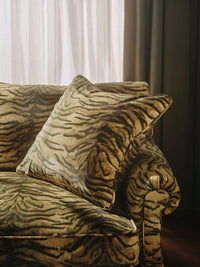
From Prince’s fur guitar strap to the Sex Pistol’s leopard spotted shirts, animal print has always been a part of rock ‘n’ roll. For musician Simone Marie, it’s a symbol of freedom, connection, and the primal energy of being a performer.
Where once animal patterns as decoration were the preserve of royalty and the upper-classes, when they were embraced by the kings and queens of music, their exclusory heritage was subverted into something defiant, provocative and primal.
Starting with Little Richard’s adoption of leopard print from the hyper-feminine eroticism of pin-up culture in the ‘50s, to the rise of glam rock and punk in the ‘70s, animal print became a clarion call; an emblem of the rejection of mainstream society and traditional gender norms.
The New York Dolls’ snakeskin platforms, Bowie’s leopard lurex, Debbie Harry’s Zebra print swimsuit and The Cramps’ iconic tiger-print pants; these artists took what had been a traditional signifier of wealth and refinement, and dragged it kicking and screaming, both into the future with their progressive beliefs, and back to its roots as something raw, instinctive and unapologetically untamed.
Lou Reed told us to “take a walk on the wild side”, and we haven’t looked back since…
There’s a beautiful irony in the way that something that evolved as a way for animals to blend in, for us, became a way to stand out.
In recent years, animal print has proliferated our culture. It’s everywhere, and often decontextualised from its source; divorced from the animals that lent their patterns, and the protest and politics it came to represent. But it still holds an undeniable echo of the attitude and allure it once embodied.

As the former bassist with Primal Scream, who has worked with Johnny Marr, The Stooges’ James Williamson, Andy Bell (Ride, Oasis) and Jesus and the Mary Chain, and host of Soho Radio’s Naked Lunch, Simone Marie is no stranger to the wild side. We met the musician and DJ at her London studio to talk about the inherent relationship between these prints and music, the importance of representation and instinct, and how reconnecting with Nature could be the key to creativity and care.
The legacy of animal print and rock ‘n’ roll are inextricably linked. Bowie, Siouxie, Iggy, Blondie, Little Richard and Roxy Music are synonymous with both animal print, and a raw, rebellious, wild energy. Why do you think there is such a strong connection between the two?
Animal print is like a flag, wearing it is like not tying yourself to a nationality or religion or point of view.
I always think of that image of Iggy Pop in the jacket with the leopard print and the leather. And, you know, just the days of Raw Power and James Williamson's (Iggy Pop and The Stooges), Les Paul, which he called Leopard Lady, and recorded Raw Power on. He wanted it to growl like an animal.
So the connection is kind of visceral; it’s immediate and it's visual. I think it represents that kind of raw, primal energy that you can convey in music, whether it be through image or the sound. It links us as humans to the animal kingdom, and that untapped energy.
It represents that kind of out and out spirit, embodying that wild energy. It’s powerful. When you're dressed head to toe in leopard print, it's like, you better show up. You better do something good. You totally have to live up to it.
It’s representing yourself as a part of nature, isn't it? Sometimes you don't want to wear brands or you don't want to wear specific colours, but you want to wear something that represents something.
And, you know, an animal print doesn't have any kind of social, economic, political connotations. It's just pure nature.

Visual identity is such an important part of music. You think of Ziggy era Bowie and he’s in a catsuit, or Eartha Kitt in head-to-toe leopard. It’s part of their mythology, the symbolism resonates so strongly, like an instant, instinctual tell. Who comes to mind when you think of this animal-music connection?
I kind of immediately go to Alice Cooper with the snakes on stage. You know, it's become part of his act. We actually toured with Alice Cooper a while back and were supporting some of his shows. And I watched every show and I kept saying to one of the crew, when can I meet the snake? Can I see the snake? Everyone was like, oh God, the snake. And I was like, where's the snake? I got to hold him! And it was just incredible. People were like, you're crazy, you're mad. But I love reptiles.
It's become part of heavy rock ideology. You realise like you are up against another beast in nature. It's a powerful thing.
Do you resonate with this connection to animal print and its musical heritage, as a symbol of provocation, non-conformity and a representation of your wild side?
Yeah, for me personally, I really relate to it. It's kind of like an ode to nature, showing your respect and your love for the animal kingdom, knowing that you're not the only existence on earth. And to represent that by wearing their prints is a beautiful thing. It's powerful, especially if you see it on stage.
Playing live is such a visceral thing. And I feel like it goes hand in hand with the animalistic energy of the prints.
For me, wearing these prints represents a wild energy that you can embody. It shows part of your nature, part of your personality. It's something that's completely unique, like a fingerprint, you know, animal print. You will never see the same print on two animals. And I find that really, really beautiful.
It's like art. And it just makes you appreciate this whole human experience.

You’ve spoken about rhythm as something that is felt, rather than mechanical; that you lock in like a heartbeat. Do you see a parallel between musical intuition and animal instinct? And do you think animal print is a visual representation of that primal part of creativity?
Yeah, I think they’re two sides of the same coin. Musical intuition comes from years of knowledge and practice and working with people and knowing your own capabilities, and also putting yourself in situations where you have to rely on an unknown knowledge, or step into an unknown, and adapt.
And I'd say animal instinct is very much like that. Because they're using all of their senses and they're feeling their environment and their surroundings.
When you're in the studio, you don't know what's coming next but it feels like it has that kind of edge to it, you're in unknown territory, and you only have yourself to rely on. That's one of the exciting things about music, that no matter how much you practise, the real buzz comes from when you can't predict an outcome, and when you don't know what you're going to do in a situation. And it's that instinct between you and the audience, you and the other musicians on stage.
And what happens a lot of the time when you're in a very tight band is instinctively you share an energy that people don't necessarily see but you all know. You know instinctively where somebody might go or how someone's playing, or if somebody does something wrong, how you kind of pick that up and move around it.
Animal print is everywhere now, and culturally, we’ve become disconnected from its source - the natural world. As a musician, where authorship is so important, do you think wearing these patterns carries a responsibility to acknowledge Nature as a creator?
Yeah, I think there is a responsibility with how you represent the animal kingdom, because there is so much cruelty in the world.
And animals are killed for their skins, their hides, their tusks. So I think it’s important to bring about awareness and work with other people who embody that awareness and respect for the natural world.
It's important to do as much as you can and manoeuvre in a way that is respectful to the world around us and the other kind of sentient beings that share this earth with us - not just things that we represent on ourselves, but all nature.
We've come so far in terms of how we treat the natural world but I think we've still got so, so much further to go.

You said wearing animal print mirrors the raw, primal energy that you tap into when making music. What animal would you say embodies your creativity?
God, my music. I think, you know, it's funny. I kind of feel like it would be a cheetah because they're kind of low key on the ground. And they're always taking in their surroundings. But then when they have to go for it, it's like killer instincts, they just go for it.
And they're the fastest. I'm not saying I'm the fastest at anything, but I can identify with that energy where you're kind of bedding down, you're taking everything in, and then when push comes to shove, you just have to make things happen. So maybe a cheetah for now.
If you could have anyone’s bass up on your wall, whose would it be?
An iconic bass I would love to have on my wall would be the James Jameson Precision bass.
I think it was a 62. He's just a legendary player. I would have that on my wall, but then it's such a piece of history, I wouldn't want to have it to myself. I think other people should see it. In fact, I think it's in a glass box somewhere in some museum in America.
So maybe that or if I had to choose a bass from a specific album, it would be the one Simon Gallop used for Disintegration. That would be pretty cool.
There's just so many. It's like picking a favourite song! But, actually, one of Prince's basses. The one with the animal skin strap, the fluffy one that he wore with the pants and those boots that go up there.
Shop the Edit
Of all the iconic animal print looks, do you have a favourite?
Oh, God. I feel like Slash, with the snakeskin, Alice Cooper, with the snakeskin. Prince as well, in all the animal prints. Bowie, Siouxie Sioux. Everyone from the ‘70s. Brian Eno and Brian Ferry, all of Roxy Music. Those Van Halen videos with all the spandex and snake and leopard print. I mean, Spinal Tap. Where would they be without animal print?
Honestly, I keep talking about it, but that Prince look with the little pants and the waistcoat and the leopard guitar strap. I mean, it's just burned into my memory. I dare anyone to see that and not forget it.
Bootsy Collins. Iggy Pop. I mean, I had that jacket. There was this really infamous picture of Iggy. I think Mick Rock took it. He did a lot of Iggy stuff. And it's a leather jacket with leopard print down the arms and the front. And I really wanted to get one made, like a proper, real deal one. And a wonderful friend called Ava made me a version of it. So that's like my ode to Iggy Pop and his jacket.

Animal print holds an important space at the intersection of music, identity and performance. For Simone, it represents something deeper than just decoration, it’s a visual echo of the instinct that drives creativity, and a connection to something innate, profound and wildly beautiful…the natural world.
Follow Simone on socials @simonembutler, visit www.simonemariebutler.com and listen to her show Naked Lunch every Wednesday from 12-2 on Soho Radio, where she explores pop culture, counter culture and all things rock ‘n’ roll.