










A Wild Idea
By Frieda Gormley
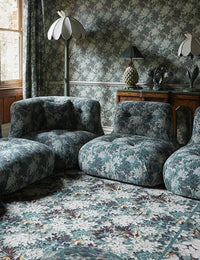
As a brand rooted in the natural world, a floral pattern on a wall or an animal print fabric is not just decoration, but a reminder of the living world we need to honour and protect. So how do we do that?
From the planting of the first seeds of House of Hackney, to the simple, beautiful idea that design and reciprocity can go hand in hand when you see natural world as a collaborator, not a commodity, read, in our founder Frieda’s words, how what started as a “wild idea”, turned out to be not so wild afterall…

What if the most ordinary pattern in your wardrobe carries an extraordinary blind spot?
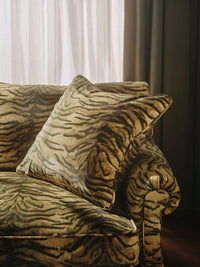
As one of the most enduring and ubiquitous motifs in clothing history, animal print has achieved a level of cultural saturation that makes its presence almost unremarkable; it’s practically a staple in the closets of so many of us. We call it Nature’s neutral at House of Hackney because it goes with everything, crosses trends and generations, and done right can still (just about) denote a signal of subversion, a trace of rebellion, and that you’re a little bit rock and roll.
In your wardrobe, it is likely to exist in the form of a leopard-print dress or shirt that gets pulled out time and time again because it goes with everything; a zebra bikini bought on holiday; a bag, scarf or accessory that weathers the seasonal trends. And if you have children - or nieces and nephews - chances are animal print appears there too, reproduced in mini scale. Yet where adults tend to treat these patterns as visual shorthand, decontextualising them from their majestic source, children often hold a much closer relationship to the animal itself. They name it. They become it. They crawl, roar, stalk - imagining its movements and sounds - instinctively placing the pattern back into a living world rather than seeing it as decorative abstraction. This connection isn’t taught; it’s remembered and innate in all of us. A natural closeness to the more-than-human world that we are born with, and then slowly unlearn as we grow up, as the prints are stripped of their origin story and animals become symbols, products, or prints, rather than fellow beings we share the world with.
However, we are beginning to remember something we once knew.

Thanks to science, and to the growing visibility of Indigenous wisdom - not a moment too soon - across culture, business and politics, we are remembering what was always true: that we are not separate from Nature, but part of her. Not observers standing outside the living world, but participants within it. After centuries of behaving as though we were above or apart from Nature, the old paradigm of dominion is beginning to give way to one of relationship, and to the understanding that the living beings we share this earthly experience with are kin. And that within this symbiotic web of interdependence and interconnectedness, the idea of mutual flourishing…
Nature doing well means we do well - because we are Nature.
This remembering is sparking a subtle but significant shift in how we think about responsibility. We are beginning to question the systems that shaped our disconnection from Nature: the economic models that rewarded extraction without reciprocity, and the ways Earth’s sacred elements were gradually commodified and reframed as “natural resources.” And as this shift gathers momentum, it invites us to look again at even the most familiar aspects of our lives, and to ask different questions of them. Including something as seemingly ordinary as animal print.
Because if we are relearning how to see ourselves in Nature rather than apart from her, then it should follow that the things we make, wear and sell, especially those that draw so directly from the natural world, begin to reflect that relationship. But what does moving from inspiration to responsibility look like in action? One place to begin is by acknowledging Nature not just as muse, but as collaborator - and designing simple, structural ways to return value to the living systems that give us so much.
For Javvy and me - my husband and co-founder - that shift in consciousness arrived slowly, as we began spending more time in Nature, observing her more closely for our designs, and paying deeper attention to the living world that had sat at the heart of our work. We too had definitely absorbed a certain unconscious decontextualization - not through indifference, but through the narratives we were surrounded by, the systems we moved through, and the curricula that teaches us separation over belonging.

I have always loved leopard print and the kind of iconoclastic charge it carries. Growing up, it felt rebellious and subversive, timeless and chic in equal measure.
Its history holds centuries of tension - power, sensuality, danger, glamour - worn lightly by those who understood its duality.
Women like Debbie Harry, Siouxsie Sioux, Madonna, Kate Moss, the Spice Girls - and some of the most stylish men too: Fred Flintstone, Little Richard, David Bowie, Iggy Pop, Bobby Gillespie - all using animal print not just as decoration, but as declaration too.
And then there was my grandmother, Peg.
Animal print flashed throughout her home and wardrobe. Her deep velvet sofa was punctuated with round “ocelot” cushions - as she liked to call them. Peg could be spotted zipping around the Francis Street area of Dublin on her motorbike, like a magnificent creature in a great coat, strappy biker boots and a chic leopard-print Cossack hat, visiting the antique dealers she was on first-name terms with. My grandmother embodied the connotations of animal print: feminine, strong, unapologetic.
My grandmother’s lair very much shaped the visual language for House of Hackney. And when we first began filling in the blank canvas for our inaugural range, I knew we needed the perfect leopard print for our wallpaper and fabric collections: in the perfect scale (too big and its vulgar, too small and it’s a blob), and in the perfect buttery taupe, lifted with highlights of bitter chocolate.
The most beautiful example I’d ever seen was in photographs of Jean Cocteau’s house in Milly-la-Forêt, just outside Paris, decorated by Madeleine Castaing - fabric-covered walls that transported you to the savannah. This was animal print as atmosphere and the chicest home office I will forever recreate. So, we made a pilgrimage there, two toddlers in tow, to sketch it. That sketch would become WILD CARD.

WILD CARD began its life as fabric and wallpaper, before transmuting into other products. The right leopard prints just made everything instantly chic. At that point, our focus was firmly on manufacturing. This was 2011, and the high street reigned supreme. Disillusioned with the model and having left my job as a high-street buyer at Topshop, where leopard print was ubiquitous, disposable, and endlessly churned out, the founding principles of House of Hackney were directed squarely at the exploitative system itself.
We wanted to challenge a model that had been normalised and widely accepted, with little consideration for its social or environmental impacts, and instead create products made to last.
Products made in the UK, by generational factories that cared for their workers. Products made-to-order, so there was as little waste as possible.
Our WILD CARD leopard print fabric was woven by Suffolk weavers. Our teacups were made in Stoke-on-Trent, the home of fine bone china. Our beautiful wool blankets - still one of my favourite products to this day and may just need a rerun - were made by Johnstons of Elgin in Scotland. Later, WILD CARD would be translated into carpet, manufactured by Axminster Carpets in Devon. Each factory was rooted in place and was committed to local employment and materials and quality that lasted. My love for leopard print in interiors reached new heights once we wove the design into a jacquard and created our first WILD CARD sofa. A deep, sunken piece that became our family sofa and passed every practical test - comfortable, forgiving, and robust - where sticky paw prints were easily wiped away and easily camouflaged by the pattern itself.
So yes, we were uncompromising about manufacturing. Working with the best of the best was our mission, and in many ways, our form of protest against the prevalent high street system. But it would take a little longer before we began to look beyond how our products were made, and towards the deeper question of where the prints themselves came from, and what worlds they belonged to.
It was the creation of our SABER cushions that moved the dial for us. As we researched the Himalayan big cats that inspired the design, we realised that the beauty we were borrowing from was inseparable from its vulnerability.
These were not abstract symbols, but endangered beings living within fragile ecosystems that were under immense pressure.
From that point on, we could no longer pretend that inspiration existed in a vacuum. So, we began funnelling sales from our sabre-toothed tiger cushions directly to Panthera, supporting the protection of jaguar corridors in Latin America and endangered tiger populations in India.
With tree motifs a recurring symbol in our work, this was followed by a series of partnerships - first with Friends of the Earth, then the Woodland Trust. Over time, a principle began to take shape; that every textile we create should carry a thread back to the ecosystems it draws from through beauty, storytelling, restoration and activism.

A pattern on a wall or a fabric is not just decoration, but a reminder of the living worlds we need to honour and protect.
The question for us was no longer simply how to be inspired by Nature, but how to be in the right relationship with her - the muse of our entire brand, the foundation of all life.
It led us to start asking different questions of our own work: how can responsibility accompany inspiration? What does reciprocity look like when a business profits from the beauty of the natural world? How do we bring the voices of Nature into our decision-making so that we are truly considering the needs and impacts on other stakeholders we share this world beyond us humans? And how might those values be embedded structurally and formally, rather than expressed only through intention?
Our earliest responses were imperfect but sincere - directing proceeds from animal prints towards wildlife conservation, working with Friends of the Earth and the Woodland Trust supporting forest protection through tree-themed designs, and building long-term relationships with organisations working on the ground. Those gestures became commitments, and gradually those commitments became systems.
Appointing Mother Nature and Future Generations as a director marked the moment when Nature’s voice moved from the margins to the centre of our decision-making. No longer an external concern, an impact report, or a downstream consideration, Nature was now present - formally, structurally - in the room where decisions are made.
And with that everything changed.
Nature was no longer just our muse. She was our director, our teacher, our collaborator.

And like all collaborators we worked with they deserve to be acknowledged and remunerated for the exchange. We had been taking her forms and her visual language and turning them into products. We were commissioning print designers and purchasing archive prints from libraries that often carried licence fees, recognising authorship, valuing origin, and paying for use. And yet Nature, the source of all that inspiration, went unacknowledged and unremunerated. Why was the original author - whose designs predate us by billions of years - written out of the transaction altogether?
Of course, Nature - in her generosity - is not asking to be paid, but to be in a relationship and to work within a system where reciprocity is the organising principle. This is how Nature operates, and how Indigenous cultures around the world have lived for millennia: take only what you need, take with permission, and always give something back. Nothing is taken without consequence; nothing exists in isolation. It is very simple and beautiful. And when we align with Nature’s own logic, equilibrium returns, life flourishes, and abundance flows.
Our economic systems, by contrast, have been built as a one-way street. They reward taking without returning, extracting without repairing, borrowing without acknowledgment. Over time, this has normalised a culture in which responsibility is diffused, and accountability disappears, not because people are inherently careless, but because the systems they operate within make exploitation feel ordinary, even inevitable.
Which is why the issue here is not individual consumption, or personal guilt, or what anyone chooses to wear. The problem is a structural one. It makes me think of the phrase “be hard on systems, not on people,” often attributed to Donella Meadows - a reminder from systems thinking that individual behaviour is shaped, constrained and normalised by the structures we build around it.
Change does not come from blaming people, but from redesigning the system itself.
So, if our businesses profit from the beauty, intelligence and symbolism of the natural world, how might we redesign those systems so that giving back is no longer optional, but inherent? If Nature is a collaborator, not just a backdrop or a resource, but an active contributor to value, then she must be acknowledged within the systems that profit from her, not symbolically or voluntarily, but structurally.
We propose the idea of a Nature Licence Fee as a simple, practical response. A small, built-in contribution that returns a percentage of revenue to the living systems a business depends on, not as charity or offsetting, but as a licence to use, protect, and restore the living systems from which that inspiration is drawn. And this kind of in-setting mechanism is already beginning to happen.
In the music industry, EarthPercent, founded by Brian Eno (thank god for the endless future-imagineering of Mr Eno), is built on a beautifully simple provocation: if artists sample, echo or are inspired by the sounds of Nature - birdsong, waves, wind, rain - then Nature is a silent collaborator in the work, and she should receive a share. Musicians and labels pledge a small percentage of their revenue, which is then channelled directly into climate and Nature restoration.
There’s something beautifully poetic about the fact that the man once wearing leopard print at the outer edges of Roxy Music’s glam era is now helping design a system that gives Nature credit for her contribution.

For us, the same principle applies to design. If Nature is shaping the work - visually, materially, symbolically - then she is already part of the creative process. A Nature Licence Fee extends this logic into the worlds of fashion, interiors and business, offering a practical way to turn inspiration into reciprocity, and beauty into care.
For us at House of Hackney, this thinking has become a reality. Our charity micro partnerships have now evolved into a formalised Nature Licence Fee. With our new collection, UNTAMED, a portion of all sales goes directly into restoration through our ongoing partnership with the World Land Trust. Through them, we help fund the protection of thousands of acres of sacred forest every year - rainforests in Brazil, cloud forests in Ecuador, wildlife corridors in India. These are living landscapes that are home to endangered species, and to the native communities whose stewardship is the proven guide for living in balance with the land.
Imagine if, just as companies pay licence fees to use designs, images or ideas created by others, they were required to return a small percentage of their sales to Nature. A licence to continue borrowing from Nature, with added responsibility.
If applied across UK business, a one per cent Nature Licence Fee would generate over £32 billion every year for restoring ecosystems, protecting biodiversity and supporting frontline communities.
Because without fertile soil, clean water, stable climates and thriving communities, there is no economy. The cost of biodiversity collapse far outweighs the cost of prevention. Regulation is always cheaper than repair.
Yes, times are tight, but even one per cent of sales directed towards protecting Nature would be transformative, and the truth is that at the current rate of ecosystem decline we cannot afford not to. It would be the best return on investment on anything we could possibly spend our budgets on.
Critics will call it idealistic, perhaps even utopian. But corporate taxation once sounded utopian. So did the NHS. So did maternity leave. So did net-zero commitments. Many of the rights and protections we now take for granted began their lives as ‘impossible’ ideas.
And if reciprocity is the principle, then the other side of the coin is equally important: recognising and rewarding the businesses that actively regenerate the living world. Just as there could be a small fee for using Nature, there could also be tax breaks, reduced business rates or preferential procurement for companies who measurably give back - those who restore biodiversity, build soil health, protect water systems, support Indigenous land guardianship, or demonstrate circular, repair-based production models. In other words, the organisations that enhance life would be rewarded, as public money flowed to the businesses that replenish the commons rather than those that deplete it. The incentive would be loud and clear: the more companies restore, the more they benefit. Ultimately, this would reframe the very paradigm of business, with success defined not just by what life is taken but by the life that is replenished.
It’s about time we acknowledge that Nature’s motifs aren’t ours to simply extract or commodify, but gifts that carry responsibility.
By naming and remunerating the natural world, we turn design into reciprocity, and the beauty in our products translates into protection in the wild.
It’s really not such a wild idea. Is it now?
Find out more about House of Hackney's impact, and how we’re changing our business to work more in harmony with Nature - as a collaborator, not a commodity.
OUR IMPACT
Related Stories


